1st Royal Tank Regiment Historical & Interest Notes
Of A More Topical Nature Than The Official History
Started: 28th September 2005 - Page 4 Update: 19 Sep 2012
http://www.firstroyaltankregiment.com/index2.html
| 1. | 1 RTR Sports 1955 |
| 2. | Evolution of 1 RTR |
| 3. | Service Notes |
| 4. | The Mediterranean Theatre of 1 RTR |
| 5. | History of 1 RTR up to 1955 |
| 6. | The Black Beret |
| 7. | The Battle of Tofrek |
| 8. | 30s Tank |
| 9. | Detmold 1952 |
| 10. | |
| 11. | |
| 12. | |
| 13. | |
| 14. | |
| 15. | |
| 16. | |
| 17. |
| 1. Sports and 1 RTR | |||||
| The Regiment has
always been proud of its sporting record. After being reformed in 1934
th Regiment from 1935 until 1945 was seldom in one place long enough to
train up to championship standard. When Lieut Col. Sleeman took command
in 1945 he devoted a great deal of energy to sports. Under his command
the Regiment excelled in particular at Athletics, and subsquently
maintained its standards during the periods when Lieut-Cols. Gough,
Sturdee and Hopkinson were in command. In 1948 we were Rhine Army
runners up at Athletics. In 1949 we were again Rhine Army Runners up. In
1950 the Regiment was placed 3rd in the Rhine Army championships after
winning the 7th Armoured Divisional championships before again becoming
runners up in Rhine Army in 1951. In 1952 after a very successful year
in which we were again runners up in Rhine Army championships, we were
Third in the British Army championships held at Aldershot. The record
time set up by the Regimental 220 yards relay team in Germany has yet to
be beaten. The Regiment was represented in the Rhine Army swimming
finals for four consecutive years ending in 1952. We were also either
hrst or second during this period in the 7th and 11th Armoured
Divisional championships. The Football Eleven won the Southern BAOR Units League (ZECO League) for three years running as well as the 7th Armoured championships in 1950. In the 1948~49 season the Rugby Fifteen reached the Rhine Army finals being beaten by an Airborne Sapper Unit. The ‘Seven a Side team also reached the Rhine Army finals in 1951 but they were also beaten. The Regimental Squash team reached the BAOR semi-finals in 1952. A Rhine Army championship was won by the Water Polo team in 1951 and this same team became semi finalists in the Army championships held later that year in England. The Regiment also entered a team for the Army Pentathlon for the three years prior to Korea and competed favourably with teams from England. Individuals who have received Army colours in recent years are: Lieut. Farmer - Army Champion 440 yards. . Sgt. M.cLaughlin - Army Light Weight Champion, Sgt. Keetch - 220 yards sprint. Cpl. Hemm represented England in the 1952 Olympics. Sgt. Prowting - Army ]avelin. Lieut. Vickers - Army (Egypt) Squash Champion, 1954. Among the many who have recently received Rhine Army colours for various sports are: Major Maunsell AQMS. Meakin Captain Kingsford Sgt. Hunter Lieut. Cockman Sgt. Prowting Lieut. Davies Sgt. Upiohn Lieut. Sinnatt Sgt. Lines Lieut. Bennett Tpr. Pearson Lieut. Vickers Tpr. Brown Lieut. Farmer Tpr. Butler From 1948-52 the Regiment was very fortunate in having as its QMSI, A. Y. Slater (APTC) who with Herr Christman (a German ex-Olympic Trainer) was largely responsible for the very high standard attained by several of the Athletes. |
|||||
2. Evolution of 1 RTR |
|||||
|
3. Service Notes |
|||||
| 4. The
Mediterranean Theatre of 1 RTR |
|||||
|
5. History of the 1st
Royal Tank Regiment
INTRODUCTION This pamphlet has been prepared so that all
members of the 1st Royal Tank Regiment can learn, in an easily
digestible and readable narrative, the History and Traditions which the
Regiment has built up since its foundation in 1916. Also included in the pamphlet is some information
on pay, leave, terms of service, etc., which are thought to be of
interest to serving soldiers. J.A.S. June, 1955 EVOLUTION OE THE BRITISH TANK AND WORLD
WAR I Although the concept of an armoured vehicle is
not a new one the Tank, as we know it was born in the 1st World War. Its
purpose was to break the deadlock on the Western Front which since the
end
of 1914 consisted of continuous trench systems
protected by barbed wire, in which the machine gun played a major role
in the defence. Several people claim to be the original inventor of the
Tank (so By August, 1916, the expeditionary forces had
received 150 tanks. These were manned by a newly formed force called the
Heavy Section (later " Branch ") of the Machine Gun Corps (again for
security reasons). The Corps was divided into 6 Companies (A to F) of 25
tanks each "A" Company being commanded by Major C. M. Tippetts (South
Wales Borderers). There were two types of tanks Male and Female. The "
Male " tank was fitted with two six pounder guns which fired H.E. and
was designed for the task of destroying enemy machine guns. The "Female
" tank was fitted with four machine guns and its task was to kill enemy
infantry. These tanks were cumbersome, unreliable and had a maximum
speed of 3 miles per hour. They were first used in the Battle of the Somme
in September, 1916. In spite of the appalling going, mechanical
breakdown and the scepticism evinced by the majority of the army, the
few which reached the German trenches struck terror in the hearts of
their opponents as one airman radioed "A tank is walking up the High
Street of Flers with the whole British Army cheering behind."
No great success was achieved in this battle
since so few tanks reached the front line and the "going " was
impossible, but the few that did, proved that we had a new and valuable
weapon. By November, 1917, we had 500 tanks in France. These were
divided into 9 tank Battalions - the force having been given the name of
" The Tank Corps " and each Battalion was designated by a letter and
given a colour or combination of colours for easy recognition. Battle of Cambrai, 1917
The lessons of the Somme in 1916 had been learnt,
and for the offensive in 1917 the Tank Corps were allowed to select the
most suitable ground over which to advance. This ground contained the
small village of Cambrai. The British aim was to break through the
Hindenburg Line, a very strongly defended trench system backed by two
canals. At first light on the 20th November, 1917, the
late Brigadier-General Elles (later Sir Hugh Elles) led the first wave
of tanks in his tank "Hilda." All nine Battalions·" A " to " I " took
part and were organised in three gigantic waves. The first wave of tanks
carried fascines (huge bundles of faggots which could be dropped into
the trenches and so enable the tanks to cross) and had the task of
breaking through the wire and trenches of the Hindenburg Line. The
second wave was to secure the crossing of the St. Quentin’s Canal. The
third wave was to exploit the break—through and cause havoc in the
enemy’s rear. The first and second waves admirably carried out their
tasks and " by 4 pm. on the 20th one of the most astonishing battles in
all history had been won and, as far as the Tank Corps was concerned,
tactically finished, for, no reserves existing it was not possible to do
more than rally the now very weary and exhausted crews, select the
fittest and patch up composite companies to continue the attack." By the 22nd more ground had been won than in any
comparable period of the war, but tragically, due to the unforeseen
successes of the Tanks, cavalry and infantry were too far behind to
exploit the victory and the Germans had time to stop the gap. Captain
Wain of " A " Battalion was awarded the Victoria Cross during the Battle
of Cambrai. Two flags flown by the Battalion in the battle are now
encased in the Officers’ Mess. One of these was carried by the
Commanding Officer and the other by " C " Company Commander. 1918
The success of the tanks at Cambrai was so great
that they were used in increasing numbers in France, and even saw action
in Palestine at Gaza under General Allenby. In fact, by the end of the
war there were 22 Battalions. INTER WAR YEARS The Armistice 1918-1939 With the Armistice the
1st Battalion moved to Bovington and formed the Tank Corps Depot being
called the 1st (Depot) Battalion The Tank Corps. In 1923, His Late
Majesty King George V honoured the Corp by granting it the prefix "
Royal." In spite of the successes achieved from 1916-1918,
conventional military thought after the
war foresaw little future in the tank ant the disbandment of the Corps
was suggested. It was largely due to the devoted efforts of many
officers, amongst whom Generals Sir Hugh Elles and Sir Ernest Swinton
were prominent that the Corp which had been reduced from 8 to 4 active
Battalions (apart from the Armoured Car Companies in India) remained in
being. 1st Battalion reformed 1934 In 1930 an experimental Brigade of two battalions
was formed and in 1931 it was augmented to three battalions. But in 1934
2 permanent formation was created (the forerunner of the present
Armoured Brigades) ; it was called " 'The Tank Brigade," and consisted
of the 1st (Light) Battalion and the 2nd, 3rd and 5th Battalion of the
R.T.C. Brigadier Hobart (later Major General Sir Percy
Hobart, K.B.E. C.B., D.S.O., MJC.) took a prominent part in the
organisation and training of this and subsequent experimental
formations. The " First " had been temporarily formed in 1933 but were
reformed on a permanent basis in 1934 by incorporating the Light Tank
Companies of the 2nd, 3rd and 5th Battalions. The " First " were
equipped with Vickers Mk. II and Mk. III tanks and Carden Lloyd
carriers. 'The issue of Mk. V’s followed in 1935 and Mk. VI’s in 1937. With Italy’s invasion of Abyssinia in 1935 the
1st Battalion was moved to Egypt. It returned to the UK in November,
1936. Its stay at home was shortened by the Munich Crisis in 1938 when
it again embarked for Egypt where it became one of the founder
Battalions of the famous 7th Armoured Division (The Desert Rats) which
was formed by General Hobart in 1939. 1939 " R.T.R. " By 1939 the Cavalry Regiments of the British Army
lost their horses and became mechanised, and they with the Tank
Battalions became part of the Royal Armoured Corps. To prevent the
anomalous situation of having a Corps within a Corps the RTC was
re-designated the Royal Tank Regiment and " Privates " became " Troopers
". World War 2 The Desert Campaign After an uneasy period of tension on the Libyan
Frontier, fighting started with Italy’s invasion of France. Britain at
this time was at her weakest.
June, 1940. General Wavell’s
first task as C. in C. was to gain enough time to build up his strength.
To this end he embarked upon a series of small frontier raids designed
to harass the Italians and mislead them as to our numbers. The " First "
were " blooded " in these actions which took place largely in the area
of Fort Capuzzo.
August, 1940. In August the
Italians crossed the Egyptian Frontier and advanced to Sidi Barrani,
halting there to build a base for further operations. December, 1940. By
December General Wavell had available for a limited offensive two
Divisions, some 40,000 men, and with these he planned to drive 250,000
Italians from Egypt. The " First " equipped with A 9’s as well as light
tanks, took part from the start in this audacious offensive. Advancing
on Sidi Barrani, the 7th Armoured Division broke through an undefended
gap resulting in the capture of 20,000 Italians. General Wavell quickly
seized the chance of turning this limited offensive into a full scale
attack and the two Divisions advanced to Bardia, where many more
prisoners were captured, and on to Tobruk (a heavily defended supply
port), Derna and Mechili.
February, 1941. The Italians had
received such heavy losses that they decided to evacuate Benghazi before
the British approached too closely. The RAF reported signs of this
evacuation and accordingly 7th Armoured Division was sent the one
hundred miles across the desert from Mechili to Beda Fomm to cut off the
Italians. The " First " with ten cruiser and nineteen light tanks had
more runners than the other Regiments and so they were kept in reserve
whilst the 3rd, 7th, 11th Hussars and 2 RTR threw a cordon round the
enemy. As had been hoped the Italians tried to break out of the cordon
in the 3rd Hussars sector. The " First " were called to support and in
true " Western " style were first seen speeding across the horizon
pursuing twenty Italian tanks. Half an hour later the " First " were
reported seen in the distance chasing another thirty Italian tanks in
the opposite direction, The Battle of Beda Fomm lasted another 24 hours
and at the end 20,000 Italian soldiers had been captured (bringing the
total to 134,000) together with six Generals and 112 tanks.
After advancing for 800 miles against an enemy
using five times as many tanks, the " First " were returned to Cairo to
re-fit with Matildas, A l0’s and A 13’s whilst the remaining British
forces advanced a further 80 miles to El Agheila. The great problem of
supply and very necessary withdrawal of troops for the Greek, Abyssinian
and Somaliland campaigns halted our advance. At this critical period the
German Afrika Corps landed at Tripoli, joined the decimated Italian army
and launched a counter offensive.
April, 1941. The First were
hastily moved back to the forward areas. " B " and " C " Squadrons
together with "A " Squadron of 7 RTR just managed to motor into Tobruk
before the Germans encircled the town and continued their advance to the
Egyptian frontier. Meanwhile “ A " Squadron joined 7 RTR and fought with
them in and around Capuzzo. As soon as the German offensive was halted
the two " A " Squadrons were exchanged, a destroyer making the trip to
Tobruk one night. The Regiment remained in Tobruk for the whole siege,
an episode of which they are very proud, especially as they were the
only Regiment of Armour or Infantry to do so. The Australians, who
provided the main body of the defenders, were relieved just before the
siege was raised.
November, 1941.
The Tobruk garrison broke out of the perimeter in November to meet
General Auchinlech’s
autumn offensive.
A junction with the 8th Army was
achieved after much heavy
fighting
at El Duda and very shortly afterwards a B vehicle route linking the two
forces was opened. .
December, 1941.
During December, 1941 the Regiment was so ill equipped, having at this
time a few A 9’s, A 10’s and Mark VI Vickers Light Tanks that it was
withdrawn to Alexandria. Soon after this the Germans were able to take
advantage of the British 1000 mile supply line and counter attacked
General
Auchinlech’s 8th Army which had
penetrated as far west as El Aghelia. The Afrika Corps forced back the
8th Army to a position running between Gazala on the coast and Bir
Hakiem, where the front was stabilized, as both sides were so exhausted
that a long break was needed to refit.
March, 1942.
The Regiment was moved down to a canvas camp at Mena near the
Pyramids and became part of the 1st Armoured Brigade. Here they were
re-equipped with General Grant and Stuart (also called " Honey ") tanks;
"B" and "C" Squadron receiving the former and "A " Squadron the latter.
An intensive training programme with these new machines commenced and it
was
expected that the Regiment would be
moved up to the Desert again about the middle of June.
May, 1942.
However, by the end of May, General Rommel had re--built his forces and
was able to
launch a heavy attack on our positions
at Gazala. Immediately there was heavy fighting and the
armour on both sides sustained
casualties. At midnight on the 28th of May, 1942, an order was given for
the Regiment to proceed to the Western Desert at 0700 hours the next
morning. The rest of the
night was spent in feverish
preparations for this totally unexpected move and if it had not been for
a full moon, the difficulties would have been insuperable. However, at 8
o’clock, only one hour after H hour, the wheeled party set out on the
long drive up to the front, and the tanks were loaded on rail flats. 36
hours later the Regiment was concentrated at Fort Capuzzo and from there
the tanks moved up to El Duda by night on transporters. German aircraft
attacked the column and a few lorries were burnt out. From El Duda they
moved to just south of the Knightsbridge Box and joined 4th Armoured
Brigade in 7th Armoured Division to replace a Regiment that had been
withdrawn owing to severe casualties.
June, 1942. At this time the
Battle of the Cauldron was in full swing. The Afrika Corps managed to
consolidate their gains in spite of all our efforts. For the next week
the Regiment was in action daily but received relatively few casualties.
However, on June the 10th while acting as left flank guard to the
remainder of the Brigade, the Regiment ran into a line of anti-tank guns
at Bir Harmat and in a few minutes more than a dozen Grants were blazing
furiously, besides 2 or 3 " Honeys " that had also been knocked out.
Next day, after a night withdrawal, during which the leaguer was
attacked by an enemy column, a further engagement was fought against
tanks of I5 and 21 Panzer Divisions, as they came up from the direction
of Bir Hakiem. The Regiment then withdrew northwards towards the coast.
The battles at Gazala and Knightsbridge had been lost and with them most
of the British tank strength. In these Battles the Germans had used to
very great effect their new 88 mm. gun which outranged our weapons by a
thousand yards. After a withdrawal through the Tobruk minefield by night
that was fraught with hazards since the lanes were no longer marked, the
remains of the Regiment reformed on the East side in the area of the old
battlefield of Sidi Rezegh. While the Tobruk Fortress was being invested
further engagements were fought in this area.
About this time the few
remaining tanks were handed over to the 6th Royal Tanks and the Regiment
was withdrawn to Mersa Matruh. Here it was hurriedly re-equipped with “
Honey " tanks and a few General Lees and reinforcements were also
collected. By this time Tobruk had fallen and the Afrika Corps had
crossed the wire on the Egyptian Frontier. While they were attacking
Mersa Matruh the Regiment had re-joined what was left of 4th Armoured
Brigade and an action was fought near
Minqar Qaim to the South. The enemy
however captured Mersa Matruh and the retreat continued. The remains of
the Regiment was now formed into a column together with some motor
infantry, 25 pounders and a few anti tank guns with the task of covering
the withdrawal of 8th Army. German pressure continued and gradually the
column fell back towards the El Alamein Line which was being hastily
prepared. We were one of the last Units to reach this line and the
supply of petrol was so
critical that several tanks had run out
completely and were on tow. The El Alamein Line, as it was so called,
extended for 40 miles from the Mediterranean to the Quattara Depression,
an impassable area of salt marsh, and covered the approaches to
Alexandria. In the centre of the Line were two dominating ridges,
Ruweisat and Alam Halfa. A part of the Line had been dug some months
before but for most of its length it was merely a line on the map. Here
the 8th Army finally checked the German advance; both sides
were completely exhausted and though the Afrika Corps had been able to
supply itself from our captured dumps at Tobruk and elsewhere, it had
out-run its supply line. In the early days on the Alamein Line furious
fighting took place before the enemy advance could be finally checked
and in these days the Regiment played its part nobly. However, the
Germans were held and the Middle East was saved.
July, 1942. By the middle of
July the Regiment had again lost most of its tanks and it was decided to
pull it out to Amiriya just outside Alexandria for a short re-fit. This
breathing space lasted no more than a month and in August the Regiment
was again at the Southern end of the El Alamein Line.
August, 1942.
General Montgomery assumed command of the 8th Army in August,
1942, and confronted Rommel when he made his big effort to break the
Alamein Line, and attacked the Alam Halfa ridge. In this battle Rommel’s
forces were held up at the ridge whilst attacks were made by the 7th
Armoured Division on his exposed com munications. Rommel later admitted
that his attack was destroyed by his inability to support his forward
troops. The Regiment’s part in the battle was therefore both important
and successful. October, 1942. After two months building up supplies the
8th Army was ready for the offensive. The Regiment was now
equipped with Crusaders in the " light " Squadron (A), and with Grants
or Shermans in " B" and " C " Squadrons. The battle of El Alamein
started at " last light " on the 23rd October, 1942 In the
first phase of the battle the Regiment participated in a feint attack to
the south designed to draw the German Armour, and was then with the
remainder of 22nd Armd Brigade switched to the Northern Flank. During
this move the tanks
were disguised to look like 10 ton
Lorries. A strong attack was then launched from the north. After ten
days of intense fighting, when casualties on both sides were extremely
heavy, two corridors had been punched in the German defence to the
north. " First Tanks " moved up with 7th Armoured
Division and were told to exploit the
breakthrough. They met the remnants of the German and Italian armour
after pushing through the gap and further decimated it between Alamein
and Fuka. The way was now open for a rapid advance and in the next 15
days the 8th Army advanced 8OO miles.
December, 1942, The Germans made
little effort to halt the advance until El Agheila where they had
previously been so successful. Realising that the Germans would try and
repeat their manoeuvres, Montgomery outflanked their positions at the
same time attacking frontally with the 7th Armoured Division. Rather
than risk being cut off the Germans hastily abandoned their defences and
withdrew to the Buerat Line.
March, 1943. Only one Division
could be adequately supplied until the Port of Tripoli was opened.
Therefore the advance was continued with only the 7th Armoured Division.
As the " Desert Rats " approached the Mareth Line Rommel seized an
opportunity of destroying them. To meet the threat the Division sat firm
on the commanding ground at Medenine whilst reserves were rushed up.
They arrived just before the German attack which was broken with a loss
of 52 German tanks, none of ours were lost. Rommel then withdrew on the
Mareth Line. Again Montgomery found a method of turning the position
when two Divisions found an undefended pass in the hills to the west.
Whilst these Divisions worked round the flank a moonlight frontal attack
was launched. The First were on the northern flank during the battle
which lasted for two days before the Germans broke contact and withdrew
towards Sfax in Tunisia.
While the 8th Army were
advancing through Libya, the 1st Army and Americans had
landed to the West of Tunis at Algiers, and a race now developed between
the 1st and 8th Armies for Tunis. May, 1943. After the capture of Sfax
the 7th Armoured
Division was suddenly transferred from
8th Army. and after a well concealed march of 130 miles joined 1st Army.
The Division with the 11th Hussars and 1st and 5th RTR in the lead was
the first to enter Tunis. Each Regiment claimed to be " first in." In
such a large city it is impossible- to substantiate the various claims
but a Gunner Officer, attached at that time to the " First " well
remembers nearly being shot up from behind by another Regiment that also
claimed that distinction. The German Army was
slowly annihilated and so the Africa campaign closed. The Regiment was
not
required during the Sicily campaign and
was therefore able to rest and reiit before preparing for the landing in
Italy. The Italian Campaign
September, 1943. In September
the Regiment landed at Salerno and took part in a series of spirited
battles around Mount Vesuvius which guarded the approach to Naples and
in the advance to the River Volturno. After crossing this river, the “
First " handed over their tanks to the Canadians, went on leave to
various parts of Italy and Capri and returned to England, landing at
Glasgow early in the new year. Preparation and training then started for the
landings in France. While stationed in Norfolk, Cromwell tanks were
issued. The North·West Europe Campaign On D plus 1, the Regiment landed
at Arromanches with other units of 7th Armoured Division and three days
later was in action south of Bayeux. The task of the British Army was to provide a
firm left hinge so that the Americans, to the right, could break out and
outflank the Germans. The enemy used 8 armoured divisions in the
Normandy battle and during the whole period of these operations, from 6
to 7% of these divisions were kept engaged on the British Sector.
Consequently, there was extremely heavy fighting in the very difficult
"Bocage." The " Bocage " is an area of Normandy where there are very
small fields surrounded by 3 feet high banks on which grow thick hedges
6 to 10 feet high. The main British objective was Caen. To help capture
this city, the 7th Armoured Division was directed to capture the
commanding ground in the area of Villers Bocage.
Between the 10th
and 30th of June the Regiment took part in the hard slogging light for
Verrieres and Tilly, and, when we failed to capture these villages, in
the flanking movement, which for a short period captured Villers Bocage.
In these battles tanks frequently engaged each other at less than 50
yards range and crews were confined to their turrets all day due to
concealed snipers hidden within a stone’s throw.
July, 1944.
On the 1st the Desert Rats were pulled out to rest and refi. On the 17th
they
concentrated north of Caen and took
part on the left flank of the break out from that city. This was against
extremely heavy opposition, the sort that on one occasion knocked out 8
tanks in " C " Squadron in a three hour battle. August, 1944. After 10
days heavy fighting south of Caen the Division moved back to the Villers
Bocage area. To the right of the British the Americans had broken German
resistance and were sweeping round in a gigantic right hook. British
forces immediately attacked to cut off the Germans in what was now being
called the Falaise Pocket. The " First " at the head of 7th Armoured
Division were launched from Caumont and outflanking Villers Bocage led
the way past Aunay. Just before the enemy at Falaise were completely
surrounded, the " First " were directed eastwards towards Lisieux, to
help deal with those Germans that were escaping. The " First " and in
particular " C " Squadron were instrumental in capturing this town.
After the capture of Lisieux the allied advance turned north to cross
the River Seine and then destroy the remainder of the German army in
France. The " First" were at first in the van of these operations but
were later called back to clear up large pockets of Germans that had
been bypassed in the area of Lillers and St. Pol. Massacre of Resistance in Lillers The outskirts of Lillers were held by a fanatical
force of some 2000 SS troops and, though the town was occupied with
little loss one morning, it was a major task defending it. With the
assistance of the French " Maquis," tanks moving amongst buildings and
with practically no infantry support managed to hold the enemy off.
Unfortunately, in the evening, the Regiment had to be withdrawn to
resume the advance into Belgium. As soon as the last tank left the town
the SS swarmed in and carried out a cold blooded massacre of the French
"Maquis " who had so gallantly assisted us to defend the town.
The clearing of these
and other pockets of resistance so delayed the Regiment’s advance into
Belgium that it did not rejoin the 7th
Armoured Division until the latter had occupied the town of Malines.
From Malines, the Regiment moved north to protect part of the left flank
of the Guards Armoured and 43 Infantry Division who were advancing to
relieve Arnhem.
October, 1944.
This task involved a set piece attack to capture the Dutch town of
s’Hertogenbosch (with 53 Infantry Division) followed by a rapid advance
to clear the Scheldt Estuary. During this advance of some 25 miles in
two days along roads (as no cross country movement was possible) the
towns of Udenhout and Oosterhout were captured but not without a number
of casualties. At Oosterhout, one troop of " A " Squadron captured in
half an hour a group of enemy anti—tank guns and infantry that had held
up another Regiment for 24 hours. Oosterhout also became the
Regimental home for the following month
which was the Regiment’s most happy memory of that winter.
November, 1944.
Most of the area up to the River Meuse was cleared by November and it
was while holding this river line that the ‘ First " had a novel and
unusual experience for an Armoured Regiment. The front line was too long
for the Infantry to man so " B " and " C " Squadrons were dismounted in
the area of Einighausen, on the extreme right of the 2nd Army’s front,
and there acted as Infantry.
A Squadron acted as a mobile reserve.
December, 1944. Just before
Christmas the Regiment, now again in Tanks, moved on to German soil and
became one of the few Regiments who spent Christmas 1944 in Germany.
Allied offensive operations were halted at this period whilst Hitler’s
wild Ardennes offensive was defeated. With this defeat more mopping up
operations started and the " First " were engaged until February in
clearing the area known as the Mass - Roer triangle. This operation was
undertaken in deep snow and bitter cold. The tanks were whitewashed and
many of the crews acquired white capes, usually made from sheets taken
from the local houses. On the icy cambered roads tanks became very
difficult to steer and in one or two instances roads were blocked by
tanks which found it easier to move sideways than forwards. Living
conditions were extremely hard as there was no protection of any sort
from the cold. On the first day of the operation Susteren was captured
after heavy fighting. Flame throwing tanks " Crocodiles " were used most
effectively in the capture of the next village St. ]uste.
At
Schilberg some 150 Germans and at least two, possibly,
five
heavy armoured S.P.’s were dug in in very strong positions. The Regiment
attacked with each Squadron advancing from a different direction but was
brought to a stand still. During the next two days lhit after hit was
obtained on the S.P.’s without apparently any effect each time a S.P.
fired we lost another tank, and then, possibly their task accomplished,
the Germans mysteriously withdrew.
February - March, 1945. There
was no pause after the clearing of the Mass Roer triangle for the
Regiment was continually employed in front line patrols which not only
kept the initiative on our side but kept morale high.
March, 1945. In March after a
pause for re-grouping the Regiment was used in the breakout from the
River Rhine bridgehead. Pockets of German resistance were encountered,
which were mainly fanatical SS troops, armed with tanks, SP guns and
Bazookas. The need for speed was however paramount in order to ensure
that the war did not last a day longer than necessary. It was the duty
of the Armoured Divisions now advancing into Germany to implement this
policy. Opposition was by-passed, high casualties accepted " A" Squadron
had 27 casualties between the Rhine and Hamburg), and, when as at Ahaus,
the whole Division was held up in a thickly wooded country, the Regiment
advanced by night 10 miles through the German positions. As a result
Bazookamen and Anti tank guns were
over-run and Germans sitting safely in the back areas surprised by the
appearance of 30 Cromwell tanks
thundering down the roads in the still and intense darkness of the early
hours. From this area the Regiment moved Eastwards, crossed the River
Weser at Neinburg and advanced on Hamburg. Resistance, still mostly
Bazookas) was continually met but advances of 40 to 50 miles in a day
were common. Fierce resistance was met at Soltau, which was bypassed, at
Wintermoor, and in the Forest of Langelohl area. In the latter " A "
Squadron was trapped, its front and rear tanks having been Bazooka’d. It
was only extricated after a considerable delay and suffered many
casualties.
April, 1945.
The " First " halted just outside Harburg, a suburb of Hamburg, situated
on the South bank of the River Elbe. An attack on Hamburg was not
necessary as the town was surrendered and the Regiment led the move in.
This occurred just before the
German Armies capitulated.
May, 1945. With peace the
Regiment concentrated in Gluckstadt and then in July moved to Moll in
Belguim to refit with Comet tanks. After that the " First " moved back
to Schleswig before moving to Berlin. Berlin
In August 1945 the
Regiment motored into Berlin on its tracks to join the 11th Hussars and
the non armoured parts of the 7th Armoured Division. From the
aerial of the Commanding Officer’s tank flew the flag that had been made
by Lady Elles for General Elles to fly from his tank when he was to
enter Berlin in 1919. Twenty-six years later it was specially flown out
to the " First " so that it could at last be put to its original use. We
were one of the only two British Tank Regiments in Berlin. Field Marshal
the Viscount Montgomery of Alamein, KG., G.C.B., D.S.O. inspected the
Regiment there on the occasion of his becoming Colonel Commandant. In March 1946 the Regiment returned to Schleswig
Holstein. POST·WAR YEARS Detmold
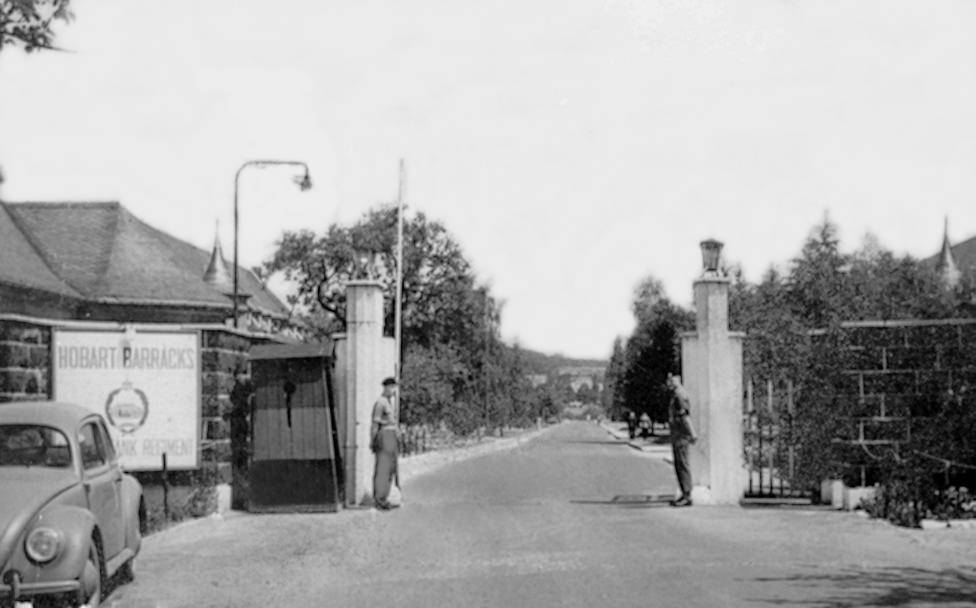
The Regiment moved to
Hobart Barracks, Detmold in July, 1946 and stayed there until embarking
for Korea in 1952. After " Exercise Broadside " in October 1950 the
Regiment joined the reformed 11th Armoured Division thus
severing a connection with the Desert Rats which had lasted, except for
a few months during the Desert campaign,
since the Division was formed in 1939.
In Detmold the Regiment
twice became the home of the RTR Corps Week (winning the Athletic
Competition on both occasions). It took part in every important exercise
held in Germany, building for itself an exceptionally high reputation
for tactical efficiency and tank maintenance. It won too, a rosette from
both 7th and 33rd Armoured Brigades for being the Regiment
most consistently " on net." During this period it was the first Regiment to
be equipped with the Mark III Centurion. The Regiment in Detmold
determined to excel at Sports as it had in the battlefield during the
war. A brief summary of its various sporting achievements will be found
in the Sports section. National Service Men We were the first Regiment to receive National
Service Men, the first draft going to "C" Squadron and the second to "B"
Besides employing the drafts as normal tank crewmen, the Regiment
undertook the task of training them in their second trade. To this end "
A " Squadron became responsible for instructing GMT, D & M, Wireless and
Gunnery. With the increased
danger of Russian aggression in 1951, " A " Squadron ceased training and
became again a Fighting Squadron. At the same time the Regiment was put
at 8 hours notice to move and remained in this state of readiness until
leaving Detmold on the 1st of September, 1952. The
Regiment in England was stationed at
Tidworth, whilst all ranks went on leave and were " kitted out " before
sailing from Liverpool on the 27th October aboard the " Empire
Halladale." Korean War
The Regiment landed in
Korea on the 6th December, 1952 and within 24 hours of arrival at the
front had taken over in the line from the 5th Royal Inniskilling Dragoon
Guards. “A" Squadron was on the right of the Commonwealth Division front
in support of 28 British Commonwealth Infantry Brigade, and " B "
Squadron on the central sector in support of 29 British Infantry
Brigade. The 25th Canadian Infantry Brigade on the left was supported by
one of their own armoured squadrons of Lord
Strathcona’s
Horse. "C" Squadron was in reserve in Gloster Valley, previously the
site of the Glosters epic stand. Because of the static nature of the War
all the tanks were dug-in in pits to protect their suspension and lower
parts. Tanks were continuously manned, which necessitated all crews
doing a watch it also meant that all drivers had to be able to fire the
gun, gunners operate the wireless and so on. Their main role was to dominate " No Man’s Land."
This they did by engaging any enemy movement, observation posts and
occupied trenches that they saw, firing pre-registered DFs by night and
firing in support of our own patrols. They could bring down fire quicker
and with more accuracy than the gunners, and so were particularly useful
in supporting patrols and in sniping work. The more interesting
operations and events in which the Regiment was engaged are as follows:
During the night of December the 11th "A" Squadron was engaged in the
Regiment’s first non routine action. A full company raid by the 1st
Battalion The Royal Australian Regiment on to enemy hills to capture
prisoners and destroy mortar positions was supported from Point 355
Right by a troop which fired 86 rounds in close support. That this
action could take place only 3 nights after the Regiment had taken over
and have such a successful result speaks well for the very high standard
of training the Regiment had reached. On January 6th a night
raid by the Duke of Wellington Regiment to capture a prisoner was
supported by two tanks of “B" Squadron, which fired between them 211
rounds. At the end of January a troop of " C" Squadron (which had taken
over from "B" Squadron) fired 250 rounds in support of another raid of
the Dukes this time in daylight, to destroy enemy tunnels. The Division
then moved into
reserve
from February through March until early April. Among the many
precedents that the Regiment claims to have set whilst in Korea was a
unique liason with American tanks. "A"
Squadron
was the first to establish this liason when they got American tanks to
direct shoots for them. This also worked very successfully in reverse
when " A " Squadron directed American tanks on to targets that they were
unable to see. It is thought that this is the hrst occasion where
unilateral fire orders have been employed. On returning to the line " C
" Squadron now in the Hook area, created another precedent with an
interesting technique for killing Chinamen at night. The Infantry using
Infra Red observed enemy at certain pre registered points and informed
the tanks who then engaged these points. A Korean Division was supported in a raid by a
troop of " B " Squadron in the area of hill 355, which engaged enemy
machine gun posts and their communication trenches to prevent the
arrival of enemy reinforcements, whilst the raid was taking place.
Later, during an enemy night attack on the Canadian Brigade, another
troop of " B " Squadron which had been engaging enemy gun flashes and
communication trenches received heavy concentrations of enemy fire in
return. That the enemy never embarked upon an operation without engaging
our tanks was to a certain degree flattering if uncomfortable. " A" Squadron took over
from " B " Squadron in the " Little Gibraltar " area in June and
supported operations by the 1st Battalions Durham Light Infantry and
Royal Fusiliers and the 2nd and 3rd Battalions, Royal Australian
Regiment. As a result of slight Chinese gains to the left of the
Division, the heaviest fighting occurred in the area of the Hook, where
after a week of heavy artillery preparation, the enemy were repulsed in
their attempt to capture the Hill. During the battle " C " Squadron
tanks fired 540 rounds of HE, and scores of belts of Besa. Later, in a
Company raid by the Kings, " C " Squadron sent a troop of tanks out to
give them flank protection and to help them regain their base. Three
weeks before the end of the War " B" Squadron took over from " C"
Squadron and were engaged in the Chinese “ last fling " attack on
American held positions just to the left of the
Hook.
The Chinese had
frequently got very close to our tanks in all sections of the front. On
this occasion the 2 inch Bomb Throwers were used on them, and in one
case when trying to shelter from friendly artillery
under the belly of a tank,
two Chinamen were shot. A truce was declared 36 hours after this battle
and the Regiment concentrated in Gloster Valley. In the six months that
the Regiment had been in the line they had fired nearly 26,000 rounds of
HE as
well as thousands of boxes of Besa, and some AP and Smoke. No mean feat
for the echelons operating in a climate ranging from 40 degrees below
zero in winter to roads knee deep in mud in the wet summer periods. The
Commonwealth Division did not yield any ground in spite of the most
determined efforts by the enemy. This feat was not without its cost, the
Infantry Battalions having very heavy casualties. The Regiment was
fortunate in only having one killed and some twenty
wounded,
although several tanks were damaged. Serving with the Regiment were many
Australian and South African Officers and New Zealand Officers and
NCO’s. They were fully integrated in
Squadrons
and there is not one of them that didn’t help weld closer Commonwealth
ties and increase the respect with which their Countries were held. In Gloster Valley the
Regiment set about building itself a camp and defence works. It then
prepared, among other things, for the handover to the 5th Royal Tanks.
We were not idle in the sports field whilst in Korea, winning the Corps
cross country and the Divisional athletics, swimming and basketball
championships. At cricket and football, although not quite so
successful, we established a reputation that we were not ashamed of. A
series of England - Australia Test Matches were
organized,
the first match being played on the 1st Tanks " Oval," a very
presentable cricket field
hewn
out of the lower slopes of Gloster Hill. The Regiment also organized a
successful sailing regatta in Japan, but had to yield pride of place to
the two Australian Battalions who were first and second. The Regiment
sailed from Korea on the 15th December 1953. THE CANAL ZONE
The Regiment arrived at Shandur in the Suez Canal
Zone aboard HMT Empire Orwell on 5th January 1954. Once again they took
over from the 5th Royal Inniskilling Dragoon Guards. As part of 25
Armoured Brigade their role in Shandur was to provide protection to
British interests in the Canal Zone. With the signing of the agreement
in Egypt the Regiment moved . In December 1954 to Genifa further North
in the Canal Zone. This was part of the plan for the gradual run down of
British Forces. Published in June 1955 |
|||||
| 6. The Black Beret | |||||
|
The Black Beret
|
|||||
| 7. The Battle of Tofrek | |||||
|
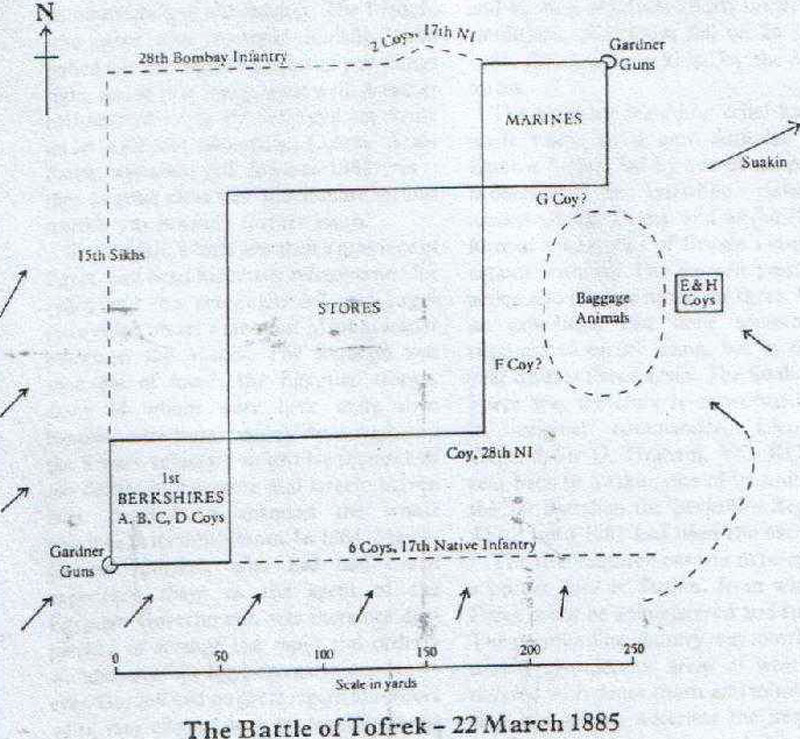
The Battle of Tofrek 22 March 1885 1st Royal Tank Regiment was located in Tofrek Barracks Hildesheim from 1984 - 1993. This is how the name came about.
|
|||||
|
8. Can You Identify These 1930s (?) Tanks? Pete Hayward found these photo's in his Dad's collection and would appreciate some background info if possible. These are images of 3 RTR.
Jul 09: Everything comes to he who waits - well, Derek Fletcher has a book of tanks from day one - here is his assessment of the above: The first picture i think you will find is a mark V light tank ent service 1935 crew 2 arm 1x77mm &1x12.7mm0.5in vickers, eng meadows 6cylinder speed 51kph / 32mph.range 125miles. second pic Mark II Light tank ent serv 1931 crew 2 arm 7.7 /303 vickers eng rolls royce 5cyln speed 48.3kph / 30 mph. Last pic Mark !! medium tank , ent serv 1925, crew 5 arm 3pdr gun 3x7.7mm /0.303 vickers 1x co-ax replacing 3x hotchkiss. Powerplant siddley 8cyl petrol speed 24kph /17mph. |
Corps Week June 1952
9. Hobart Barracks Detmold 1952